Asphalt Crack Filling in Charlotte, NC
Routing and hot-pour filling of working cracks, before water gets underneath and takes the base with it.
- Cracks cleaned and routed so the filler keys in properly
- Hot-pour rubberized filler that flexes as the surface moves
- Done ahead of sealcoating or striping in the right order
- Stops water reaching the base course, which is what actually causes potholes
Price my lot
Property type and rough stall count is enough, most lots are priced without a site visit.
Why Fine Stripes for Asphalt Crack Filling
The crack is not what wrecks a parking lot. Water getting through it is.
Once water reaches the base course under the asphalt, the base softens, the surface loses support, and you stop dealing with a crack and start dealing with a pothole and a patch. Filling early is the cheapest work you will ever do on a lot.
We clean and rout the crack so the filler keys into the sides properly, then run a hot-pour rubberized filler that stays flexible as the surface moves through summer and winter.
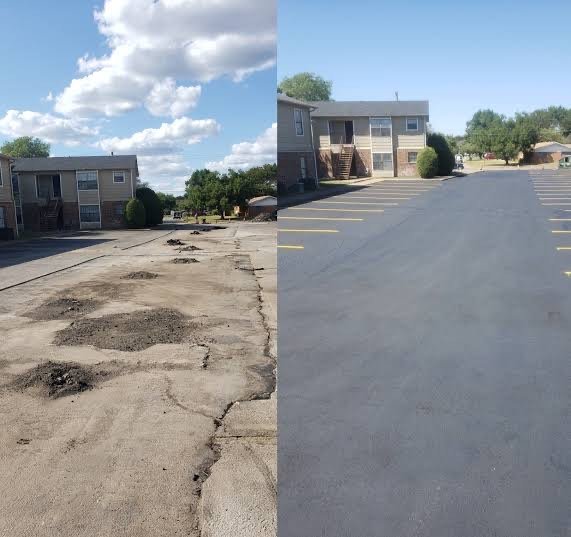
Every asphalt surface cracks eventually. Traffic flexes it, sun hardens the binder until it stops being able to move, the ground underneath shifts. A crack on its own is cosmetic. What turns it structural is that it is now an open channel into the layers below.
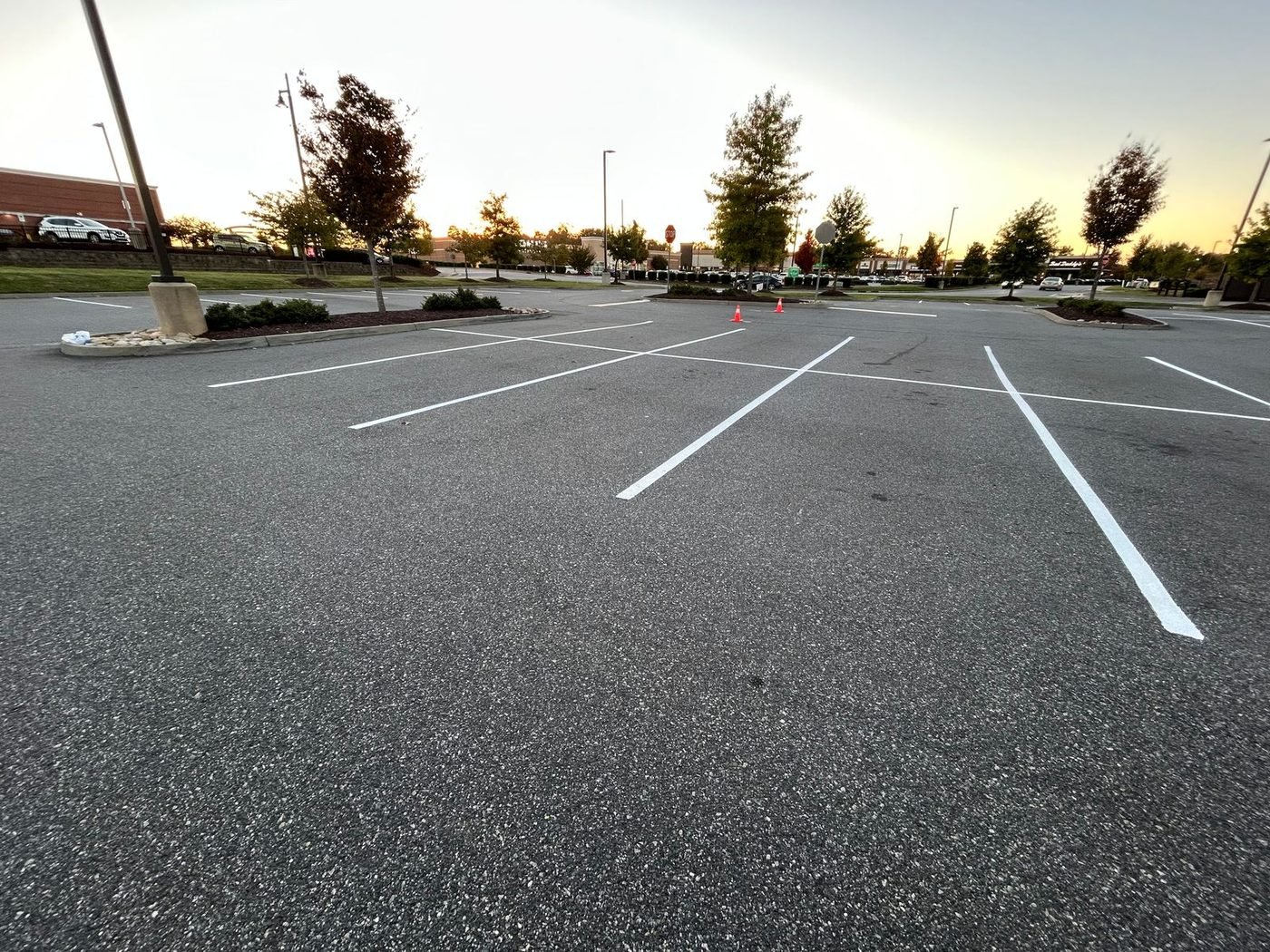
Water reaching the base course is what turns a crack into a pothole. The crack on its own is cosmetic.
Why water underneath is the real issue
Asphalt gets its strength from the compacted stone base beneath it, and that base only works while it is confined and dry. Water running down through a crack saturates it, the base loses stiffness, and now the asphalt above is flexing over a soft spot every time a vehicle passes. The surface fatigues, breaks into interconnected pieces, and eventually a piece comes out under a wheel.
Freeze-thaw speeds it up. Charlotte does not get a severe winter, but it does cross freezing point repeatedly through the cold months, which is the pattern that does damage. Water in a crack expands as it freezes and widens the crack, thaws, lets more water in. Several dozen of those cycles across one winter will open a hairline crack into something you can get a finger into.
Which is why filling early is such good value. Material and labor to seal a crack are trivial next to cutting out and replacing a failed section, and what separates the two is a couple of seasons of leaving it.
More about asphalt crack filling
Which cracks get filled, and which do not
Straight cracks running across or along the lot, cracks at the joint between two paving runs, cracks along the edge of the asphalt. Those are all straightforward candidates. They reward sealing because they are a route for water rather than a symptom of a base that has already gone.
Very fine hairline cracking will not take material at all. There is nowhere for sealant to go and forcing it just leaves a smear across the surface. Those areas are better handled by sealcoating, which is what a surface coating is for.
At the other end, an area broken into interconnected pieces that look like reptile skin is telling you the base underneath has already softened. Filling that is wasted work. It wants cutting out and patching, or replacing in a bad case, and a contractor who offers to fill it instead is taking the easy job and leaving you the real one. Cracks opened up beyond the working width of hot-pour material generally want patching too, or a two-stage treatment with backer rod.
| What you see | The right treatment | Why |
|---|---|---|
| Straight cracks across or along the lot, joint-line cracks, edge cracks | Fill | A route for water, not a symptom. Sealing rewards them. |
| Very fine hairline cracking | Sealcoat, not filler | Nowhere for sealant to go; forcing it just smears the surface |
| Interconnected pieces like reptile skin | Cut out and patch, or replace | The base underneath has already softened. Filling it is wasted work. |
| Cracks opened beyond the working width of hot-pour | Patch, or two-stage with backer rod | Past what the material can bridge |
Preparation, which is most of the job
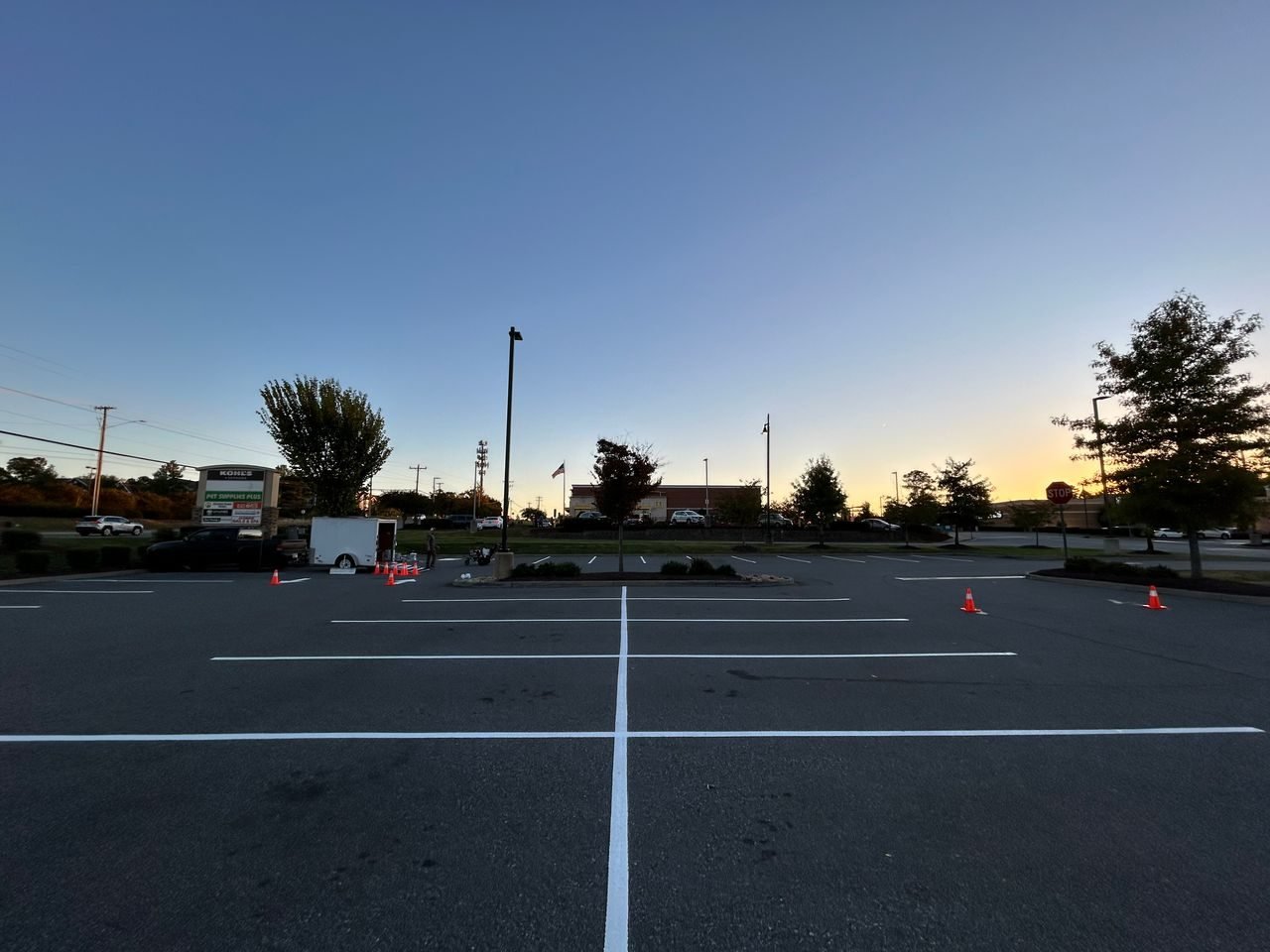
A crack is full of dirt, sand, old sealant and usually something growing in it. Sealant poured onto that bonds to the debris instead of the asphalt, and the whole bead pulls out later in one piece.
Routing cuts a clean reservoir along the crack with a carbide wheel, giving the sealant a defined shape and two fresh vertical faces to grip. That is what a router is for. Not widening the crack for its own sake, but creating a joint the sealant can key into, at a depth-to-width ratio that lets the bead stretch as the crack moves.
Then it gets cleaned out. Compressed air moves the cuttings. Where there is moisture or stubborn material a heat lance dries the crack and warms the faces so hot sealant does not chill on contact. A damp crack is a hard stop, trapped moisture flashes to steam under hot material and blows the bead out from underneath, sometimes days later.
Materials and application
Hot-applied rubberized sealant is the standard for commercial work. Heated in an oil-jacketed melter to the range on the manufacturer label, held there with continuous agitation, applied through a wand into the prepared crack. Rubber in the formulation is what lets the finished bead stretch and recover as the crack opens in winter and closes in summer. A rigid filler cannot do that, it splits away from one face.
Cold-pour materials exist and have their place on small areas and light-duty surfaces, but they cure by losing solvent or water, so they shrink. A cold-pour bead often ends up a sunken channel that still lets water in.
Finish is either flush with the surface or banded slightly over the top. An overband gives more contact area at the crack edges, though on a hot lot with turning traffic a heavy overband can soften and track. Where it gets used the band stays thin and gets dusted with a detack material so the lot can reopen quickly.
Timing, weather and the working season
Cracks are widest when the pavement is cold and narrowest in the heat of summer. Seal during a hot spell and you are filling a joint that is currently closed, so when it opens back up in January the bead is stretched thin across a gap it was never sized for. Spring and fall generally give the best compromise here, surface dry but the cracks reasonably open.
Dry is not negotiable. Surface and crack both. After heavy rain that can mean waiting a day even when the lot looks dry to the eye, and Charlotte humidity draws that out compared with a drier climate. Same reason a storm that arrives mid-afternoon can end a crack day as fast as it ends a striping day.
Order of work, and how it fits a site
Crack filling comes first in any sequence. Fill, then seal, then stripe. Sealing over a working crack hides it for one season and telegraphs it back through, and striping over it means repainting sooner than you should have to. If a lot is getting all three, the striping is the last thing to happen, and that is also the moment to correct accessible spaces that have drifted. A car space wants 96 inches of width with a 60 inch access aisle beside it, a van space 132 inches, and those are cheapest to put right while the layout is already coming off.
Crack work suits a live site because it moves in a line rather than covering an area. A crew takes one run at a time with cones and keeps nearly all the lot open, and treated cracks accept traffic quickly once cooled. Large sites usually get walked and marked out first so the property manager can see the linear footage and agree scope before a melter is fired.
Signs it was done badly
- Sealant sitting proud in a hard ridge. Poured into an unrouted crack rather than a reservoir
- The whole bead lifting out in a strip, so the crack was dirty or damp
- A sunken channel down the middle of the bead, typical of cold-pour that has shrunk back
- Sealant tracked onto the building floor. Overband applied too heavily, or too late in the day
- Cracks reappearing beside the bead rather than through it, which means the surface either side has started to fail
- Filled areas inside a section that was already broken up. That was patching work sold as crack filling
More about how to read the quote
How to read the quote
- Price by linear foot, and how that footage got measured
- Routing included, or only cleaning and pouring
- Hot-applied or cold-pour, named, so somebody can read the data sheet
- Minimum and maximum crack width being treated, so both sides know what is excluded
- Which areas are being called out as needing patching rather than filling
- How the finish gets left, flush or banded, and how quickly the lot reopens
Questions to ask
- Which of these cracks would you leave alone this year, and why?
- Is the base under this section still sound, and how can you tell?
- Are we better filling now and sealing next season, or doing both together?
- What is your cut-off for a crack too wide to fill properly?
- If it rains the morning you are booked, does the crew come back that week or go to the back of the list?
Crack work is the least visible thing done to a parking lot and the item most often deferred, which is exactly why the lots that get it done on time keep costing less than the ones that do not.
From your first message to the cones coming up
What actually happens after you send the form, in the order it happens.
-
Step : 01
Tell us about the lot
Property type, roughly how many stalls, and what needs doing. Most re-stripes are priced from that alone. For a straightforward lot nobody needs to come out before you have a number.
-
Step : 02
You get a number, and an order of work
The sequence matters more than the date. Cracks get filled before sealer goes down, and striping goes last once the surface has cured, so a full lot is usually more than one visit. That gets agreed up front rather than discovered on the day.
-
Step : 03
A window that suits the site
Days, nights or weekends. A lot that cannot give up parking during trading hours gets an out-of-hours slot; one with room to work gets coned into sections so part of it stays open throughout.
-
Step : 04
The lot gets walked first
Ideally with whoever manages the property. An oil-soaked patch by the bin store, a low spot that holds water, a section starting to ravel, wheel stops knocked out of position, parts of the layout that were wrong before anyone repainted them. Better to agree all that standing on the asphalt.
-
Step : 05
Surface prep, which is most of the job
Blowers for loose grit, brooms along the curb line where dirt compacts, oily patches treated separately. Paint will not hold on contaminated asphalt however good the paint is, and dust is the ordinary reason a new line peels off in sheets a few months later.
-
Step : 06
Layout, paint, then a walkthrough
The layout is chalked and masked before any paint goes down, measured out rather than copied off faded lines. Traffic-grade paint goes on last at a steady walking pace, and the finished markings get walked with you before the cones come up.
Paint is walk-on dry quickly and takes traffic within a few hours. Most standard lots are done in a single visit, and you get a specific window for your lot and the weather on the day.
See what customers say on Google
Our Google Business Profile carries our reviews, photos and service area, straight from Google, not retyped onto this page.
What customers wrote on Google
“Fine Stripes did the striping and sealcoating for our Fifth Third Bank location in Midtown Charlotte. Super high quality work that was completed very quickly. Everything was a breeze The traffic flows so much better now and no one is confused with the layout anymore.”
C.A Photos and Dresses Midtown Charlotte a month ago
“Tyler and his team at Fine Stripes did a great job on the parking lot at our quadplex. We had them stripe and number all of our parking spaces, and the finished product came out even better than what we envisioned.…”
Sharon Lathan 2 months ago
“We had a great experience working with Tyler and Zach at Fine Stripes. They were very communicative from the start and made things as easy as possible. The lot looks great and we’re very satisfied with the work. Highly recommend!”
Kevin Sowinski 2 months ago
“We’ve worked with Zach and Tyler at Fine Stripes on several commercial parking lot striping jobs around Charlotte, NC, and they’re awesome to work with. Super professional, easy to reach, and always show up when they say they will.…”
Beverly Charlotte 9 months ago
“Zach and his team did a great job with lining my small parking lot. They were very efficient with their time and the lines look absolutely perfect. Zach was great at communicating with me throughout the entire process. I would recommend them to anyone!”
Kelsey Miles 9 months ago
“Upon hearing that I had some way over do striping work that I needed to get done, a general contractor friend of mine referred me to Fine Stripes.They gave me a fair quote, and showed up when they said they would. They did an amazing job, will definitely use again in the future”
Amanda Redfearn 2 months ago
Common questions
Why does a small crack matter?
The crack itself is not the problem. Water running through it into the base is. Once the base softens you stop dealing with a crack and start dealing with a pothole and a patch.
Should cracks be filled before sealcoating?
Yes, always in that order. Sealer will not bridge a crack that is still moving, and sealing over one just hides it for a season.
Are there cracks you would not fill?
Yes. Once an area has broken up into interconnected pieces, filling stops being the right fix and the section needs patching or replacing. We will say so rather than take the easier job.
Where we work
Charlotte and the surrounding metro, into the South Carolina border towns.
Price my lot
Tell us the property and roughly how many stalls, and you'll get a number back, no site visit needed for most re-stripes.
Prefer to talk? (704) 741-9893
24/7 crew availability