Pavement Striping & Marking
Traffic-grade paint and thermoplastic for the markings that direct people around your site.
- Directional arrows, turn lanes and stop bars
- Lettering and stencils, RESERVED, FIRE LANE, NO PARKING, STOP
- Loading zones, speed humps and crossing markings
- Thermoplastic where markings take heavy or constant traffic
Price my lot
Property type and rough stall count is enough, most lots are priced without a site visit.
Why Fine Stripes for Pavement Marking
Markings do the job that signage cannot, they tell a driver what to do at the exact moment they need to know it. Arrows, stop bars, crossings, loading zones and lettering all keep traffic moving in the direction your site was designed for.
We use traffic-grade paint for most areas and thermoplastic where markings take a beating: entrances, drive lanes, and anywhere vehicles turn hard enough to scuff paint off the surface.
Stall lines tell a driver where to leave a car. Everything else painted on a commercial site tells that driver what to do next. Arrows, stop bars, crossings, hatching, legends, curb markings. Those carry more risk than the stalls do, because when one is wrong or worn off the mistake happens at speed, usually in front of somebody on foot.
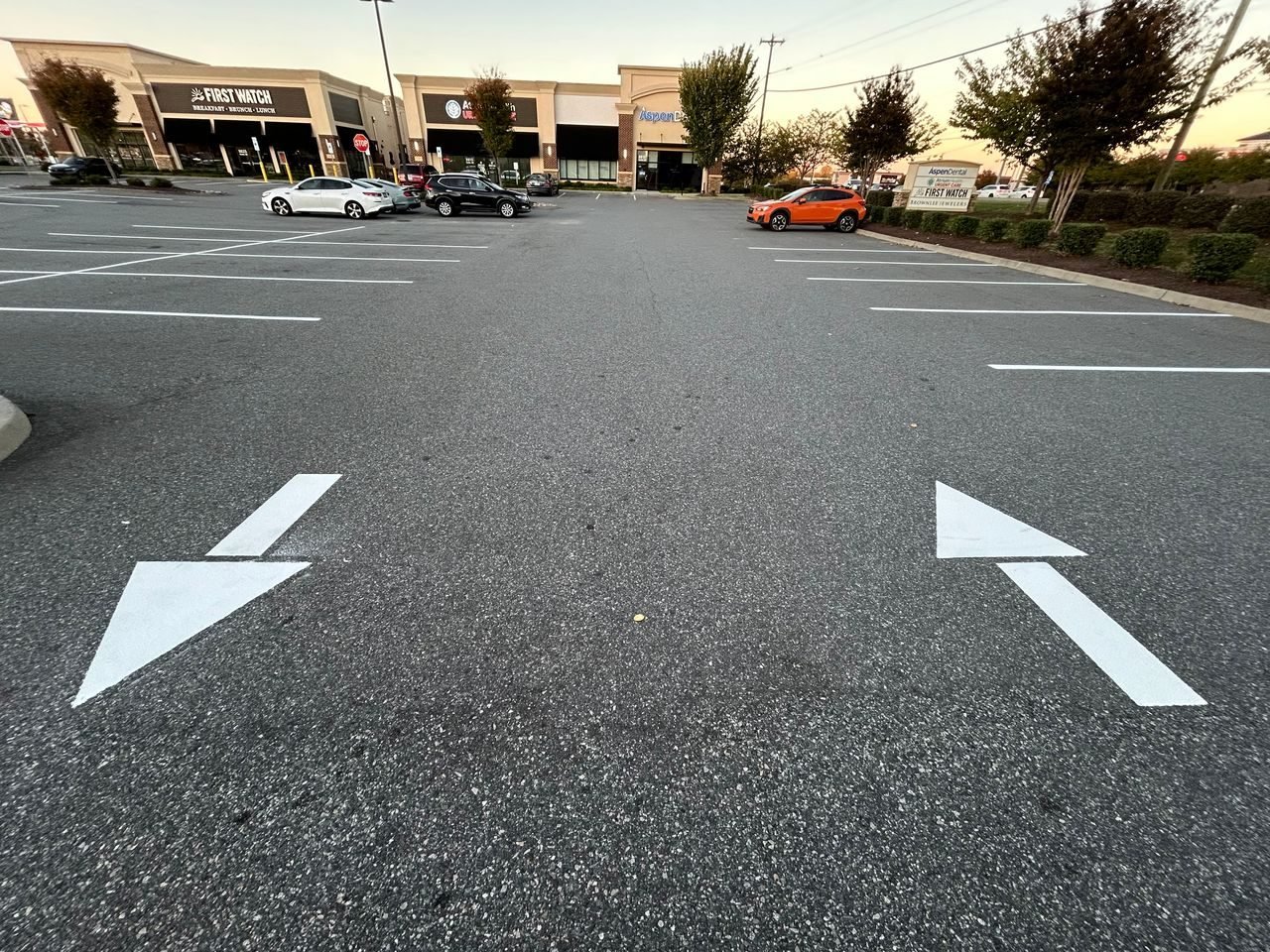
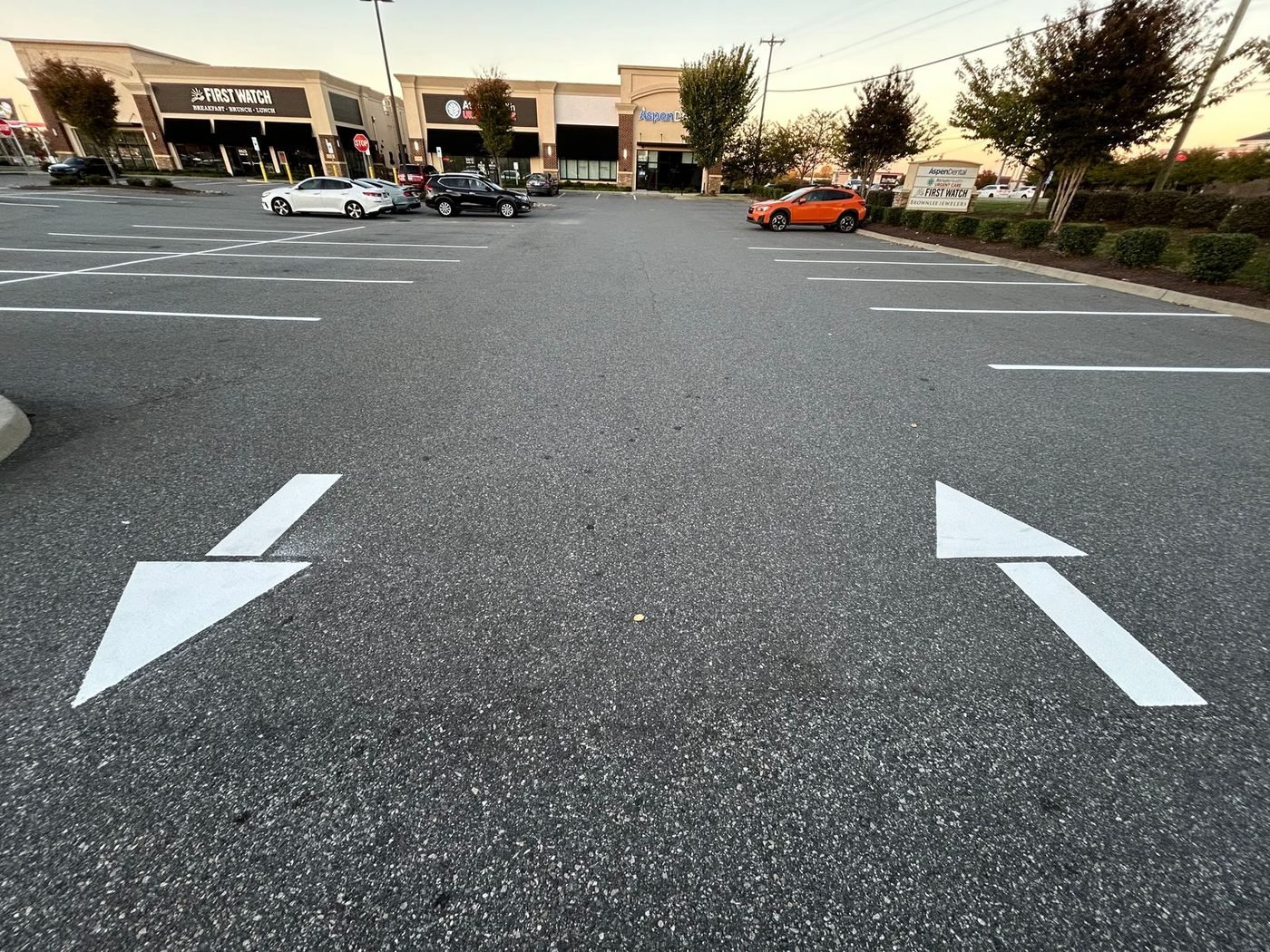
An arrow has to be readable before the decision point. Painted after the turn it arrives too late to be any use.
What gets marked, and why it goes where it goes
A commercial site normally wants directional arrows at each decision point, stop bars where an internal lane meets a through route or the public road, crossing markings on the walking routes between parking and the door, hatched areas keeping vehicles out of somewhere they should not be, and legends on the surface where a sign gets missed. Loading zones, reserved bays, no-parking areas and speed hump markings sit in the same family.
Placement is not a matter of taste. A stop bar set too far forward puts the driver past the point where they can see traffic coming. An arrow painted after the turn arrives too late to be any use. Crossings belong on the line people already walk rather than the one the layout would prefer, a crossing that ignores the natural route gets ignored back.
Shapes and legends on private property are generally drawn from the federal Manual on Uniform Traffic Control Devices, the same reference the public roads work to. Worth following even where nobody is enforcing it on your lot. Drivers read those symbols without thinking about them. A homemade arrow or an odd legend makes somebody pause and work it out.
More about pavement marking
Traffic paint against thermoplastic
Traffic paint goes on cold, dries in minutes, costs less per foot and repaints easily. That suits most markings across a parking area, where vehicles move slowly and the surface takes light wear.
Thermoplastic is a different material. It arrives as blocks or preformed shapes, gets heated until it flows, then bonds into the asphalt as it cools, leaving a marking several times thicker than paint. Glass beads usually run through the material as well as being broadcast on top, so it keeps reflectivity as the surface wears. Sensible choice for entrances, main drive lanes, turning points, anywhere tires scuff a marking under load.
What matters is not the price per marking. It is how many times somebody has to come back and redo it. A painted arrow at a busy entrance might want attention every year or two, where the same arrow in thermoplastic normally outlives several repaints of the lot around it. Where traffic is light you are paying for durability against a problem you do not have.
| Traffic paint | Thermoplastic | |
|---|---|---|
| Application | Goes on cold, dries in minutes | Heated until it flows, bonds into the asphalt as it cools |
| Thickness | A thin film | Several times thicker than paint |
| Reflectivity | Beads broadcast on top | Beads run through the material as well, so it keeps reflectivity as it wears |
| Where it earns its cost | Most markings across a parking area, where vehicles move slowly | Entrances, main drive lanes, turning points, anywhere tires scuff a marking under load |
| Repaint cycle | A painted arrow at a busy entrance might want attention every year or two | The same arrow normally outlives several repaints of the lot around it |
Surface preparation and the conditions that stop work
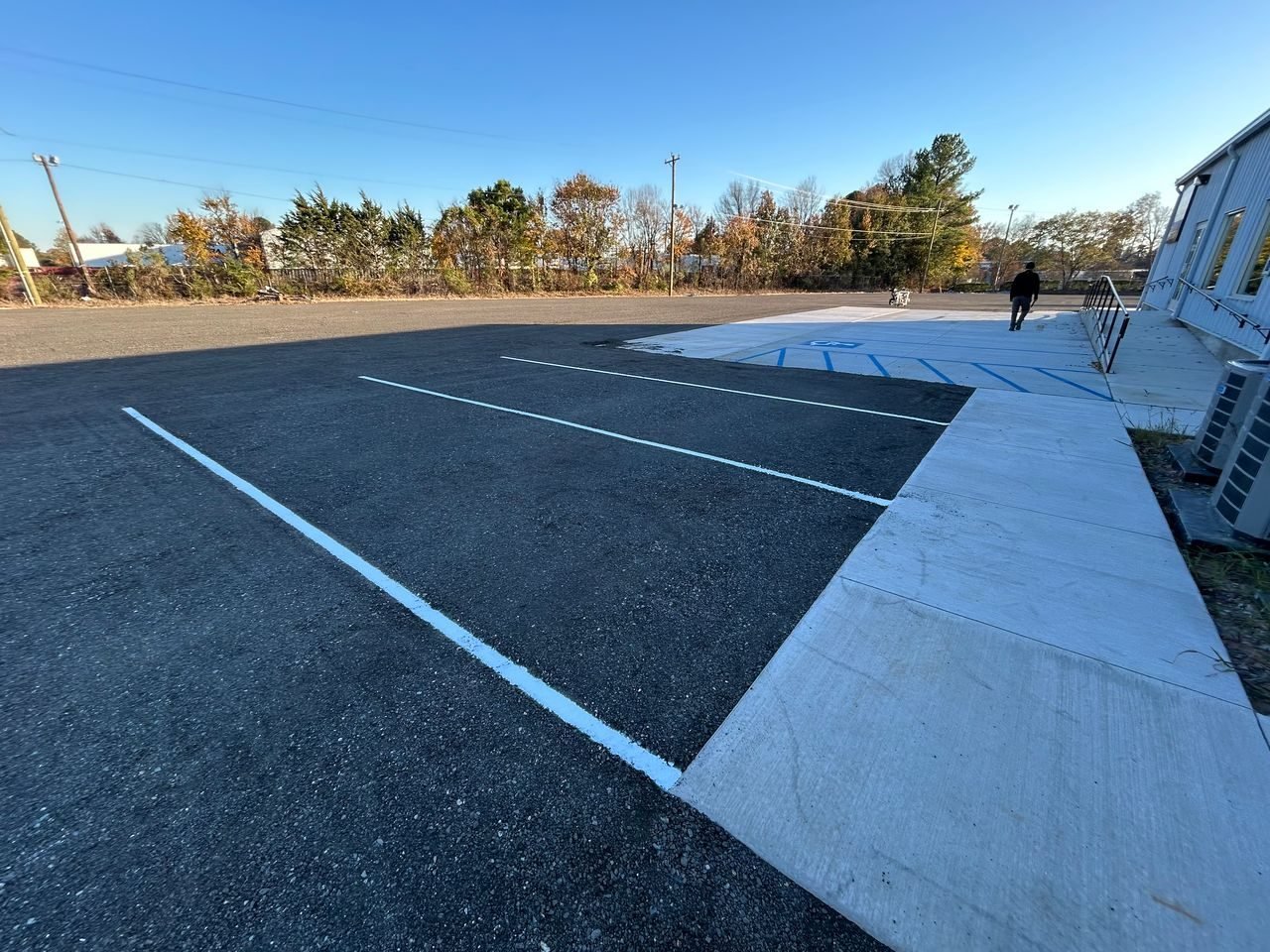
Both materials fail for the same reason. They were laid onto something they could not bond to. Loose grit, dust, curing compound, standing damp, oil, uncured sealer, any of it will release a marking from the surface, which is why a contaminated area gets cleaned properly before anything is laid onto it. Prep before thermoplastic is more demanding again because the plastic has to key into the asphalt while it is hot. Fresh sealcoat frequently wants a primer first, and skipping that leaves markings that lift as whole plates instead of wearing away.
Temperature sets the schedule. Waterborne paint wants a surface warm enough for the water to evaporate off it. With thermoplastic the asphalt has to be warm enough that molten material does not chill on contact, which through the cooler months usually means running a torch over the surface first. Summer here gives long thermoplastic windows and takes them away again with humidity that slows paint drying, plus storms that build through the afternoon and end a marking day without much warning.
Where markings and compliance overlap
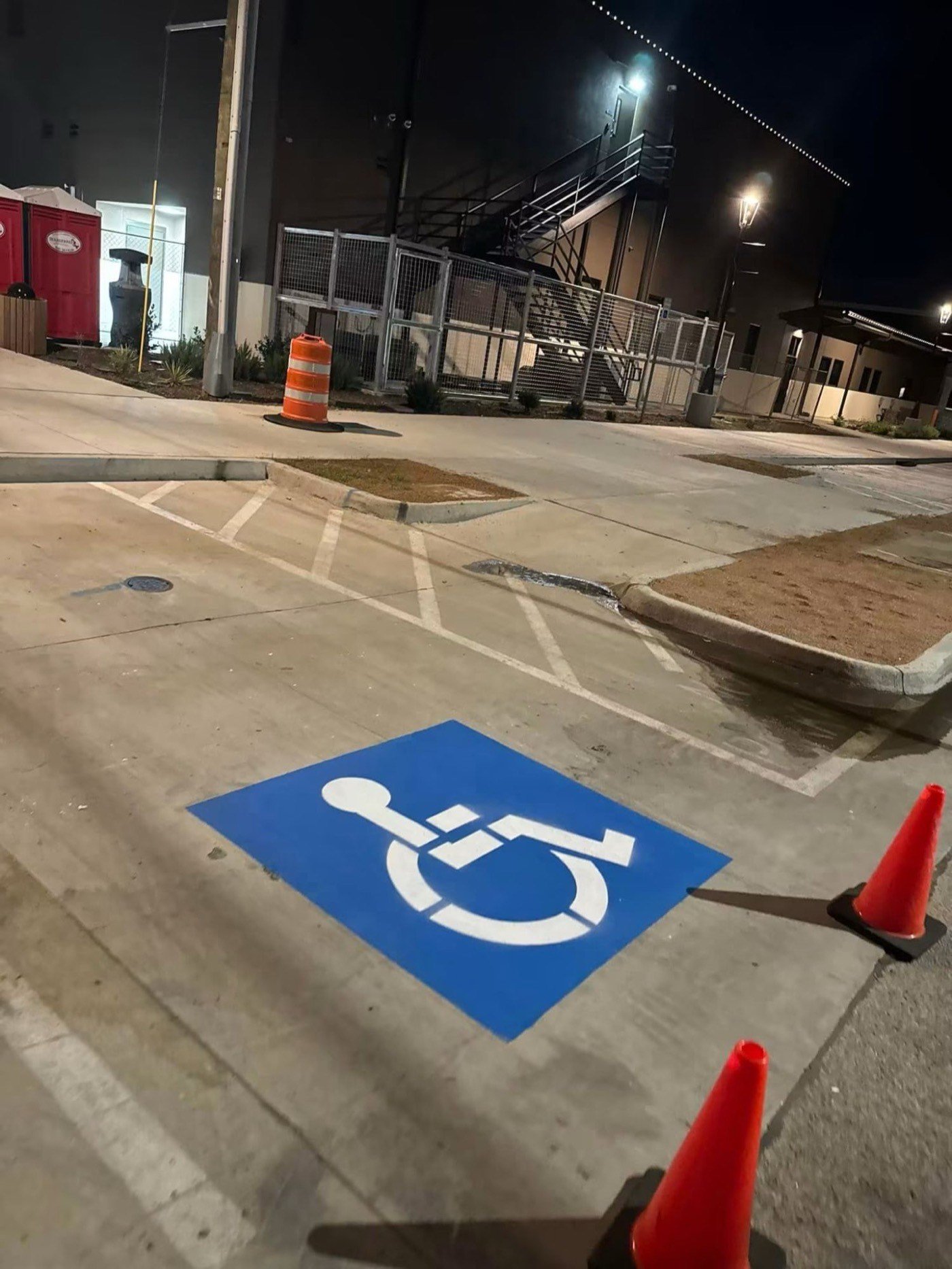
Some of what gets painted is not advisory. Fire lane markings and legends exist so an apparatus has somewhere to sit, and a faded fire lane tends to surface during an inspection rather than on a routine walk of the site. Accessible routes are the same. The crossing and the hatched access aisle beside an accessible space are part of the route from a car to the door, so when they wear off the space stops doing its job even though the stall line is still there.
Under the 2010 ADA Standards a car accessible space wants 96 inches of width with a 60 inch access aisle alongside it, and a van space wants 132 inches, or 96 inches where the access aisle is widened to 96. The aisle has to connect to an accessible route, and nothing on that route can slope more than 1:48 in any direction. Those are the numbers an inspector works from, and they are the ones most often lost when a lot gets re-striped by eye off whatever was there before.
Scheduling on a live site
Markings sit exactly where traffic is heaviest, which makes them harder to schedule than stall lines. Entrance work usually has to happen outside trading hours, there is no way to cone off an entrance and still let people in. Most sites end up split, internal markings in a quiet weekday window and the entrance and main drive lane on a night or weekend visit.
Thermoplastic does have one scheduling advantage. It takes traffic as soon as it has cooled, minutes rather than hours, so a short overnight window often covers work that would otherwise close an area until morning.
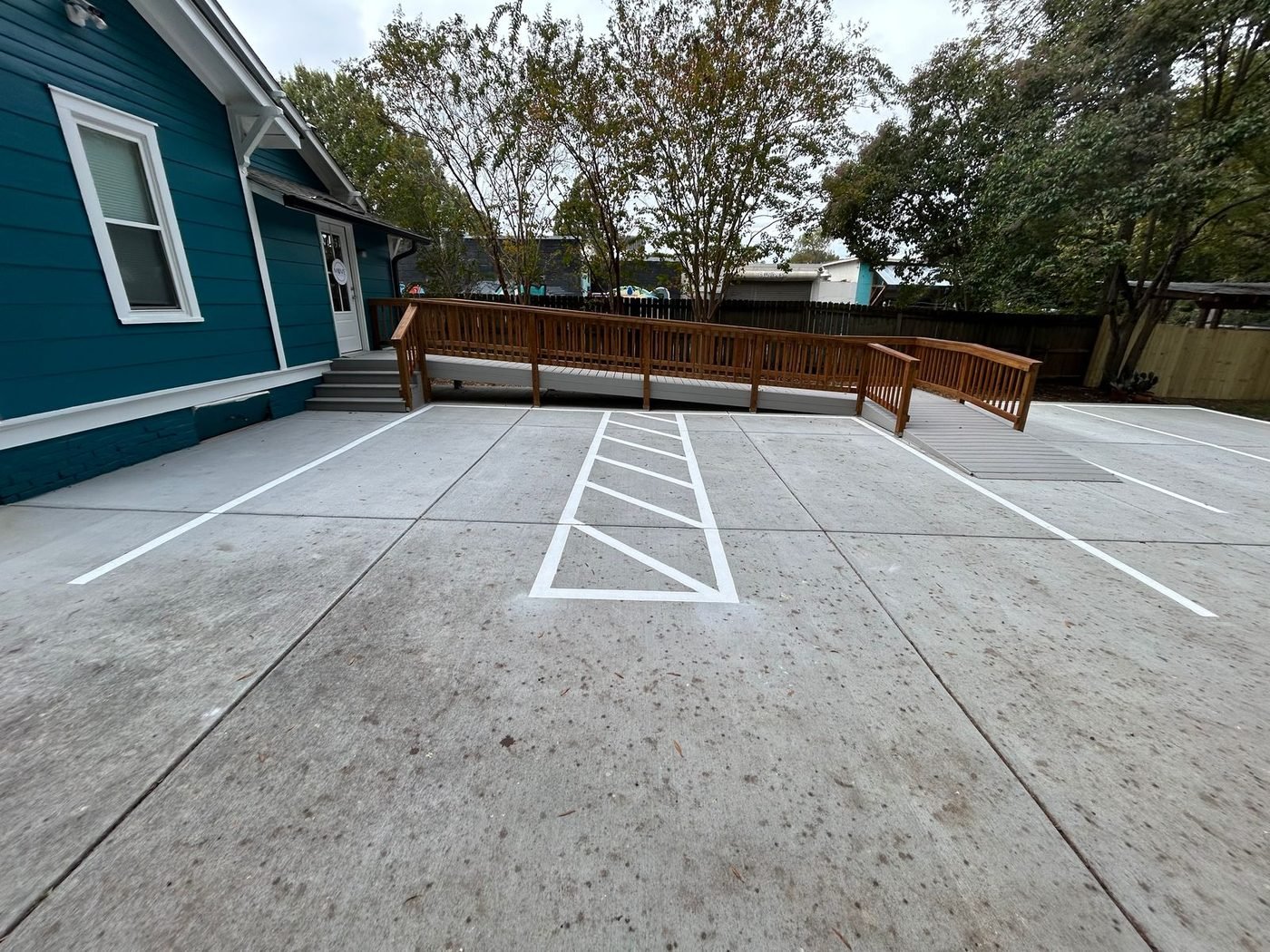
An access aisle has to be at least 60 inches wide and connect to a route that slopes no more than 1:48 in any direction.
How markings fail in practice
- Arrows that no longer match the circulation, because the site was re-laid out and only the stalls got redone
- A stop bar worn to nothing at a blind internal junction, so nobody stops there any more
- Crossings faded at exactly the point most people walk, which is where the wear is
- Fire lane markings gone illegible
- Thermoplastic lifting in one piece. That is a bond failure at application, not wear
- Hatched keep-clear areas so faint they get used as informal parking
More about judging a marking quote
Judging a marking quote
- Which markings are priced in paint and which in thermoplastic. A quote that does not separate them is not comparable to one that does
- Preformed thermoplastic or hot-applied material for the legends and arrows
- Glass beads included, and on which markings
- Primer where thermoplastic is going onto a sealed surface
- An itemized list of stencils and legends by name and count, rather than a line reading markings as required
- Is the existing layout being reproduced or corrected, and who decides that
Questions a property manager should ask
- Walk the site with me and tell me which markings you would not repaint in the same place, and why
- Which of these are load-bearing for fire access or accessibility, and are they currently correct?
- Where on this site is paint a false economy, and where is thermoplastic overkill?
- If the surface is due to be sealed within the year, which of this work should wait?
- How long after each marking goes down can that area take traffic again?
- Is the accessible signage mounted high enough? The bottom of the sign wants to sit at least 60 inches off the ground, and a sign that has been knocked low or hidden behind a parked van is the same problem as a faded stall line
A contractor with an opinion about which markings on your site are in the wrong place is worth more than one who quotes exactly what is already there. The existing layout is often just the last contractor copying the one before him.
From your first message to the cones coming up
What actually happens after you send the form, in the order it happens.
-
Step : 01
Tell us about the lot
Property type, roughly how many stalls, and what needs doing. Most re-stripes are priced from that alone. For a straightforward lot nobody needs to come out before you have a number.
-
Step : 02
You get a number, and an order of work
The sequence matters more than the date. Cracks get filled before sealer goes down, and striping goes last once the surface has cured, so a full lot is usually more than one visit. That gets agreed up front rather than discovered on the day.
-
Step : 03
A window that suits the site
Days, nights or weekends. A lot that cannot give up parking during trading hours gets an out-of-hours slot; one with room to work gets coned into sections so part of it stays open throughout.
-
Step : 04
The lot gets walked first
Ideally with whoever manages the property. An oil-soaked patch by the bin store, a low spot that holds water, a section starting to ravel, wheel stops knocked out of position, parts of the layout that were wrong before anyone repainted them. Better to agree all that standing on the asphalt.
-
Step : 05
Surface prep, which is most of the job
Blowers for loose grit, brooms along the curb line where dirt compacts, oily patches treated separately. Paint will not hold on contaminated asphalt however good the paint is, and dust is the ordinary reason a new line peels off in sheets a few months later.
-
Step : 06
Layout, paint, then a walkthrough
The layout is chalked and masked before any paint goes down, measured out rather than copied off faded lines. Traffic-grade paint goes on last at a steady walking pace, and the finished markings get walked with you before the cones come up.
Paint is walk-on dry quickly and takes traffic within a few hours. Most standard lots are done in a single visit, and you get a specific window for your lot and the weather on the day.
See what customers say on Google
Our Google Business Profile carries our reviews, photos and service area, straight from Google, not retyped onto this page.
What customers wrote on Google
“We had a great experience working with Tyler and Zach at Fine Stripes. They were very communicative from the start and made things as easy as possible. The lot looks great and we’re very satisfied with the work. Highly recommend!”
Kevin Sowinski 2 months ago
“We’ve worked with Zach and Tyler at Fine Stripes on several commercial parking lot striping jobs around Charlotte, NC, and they’re awesome to work with. Super professional, easy to reach, and always show up when they say they will.…”
Beverly Charlotte 9 months ago
“Zach and his team did a great job with lining my small parking lot. They were very efficient with their time and the lines look absolutely perfect. Zach was great at communicating with me throughout the entire process. I would recommend them to anyone!”
Kelsey Miles 9 months ago
“Upon hearing that I had some way over do striping work that I needed to get done, a general contractor friend of mine referred me to Fine Stripes.They gave me a fair quote, and showed up when they said they would. They did an amazing job, will definitely use again in the future”
Amanda Redfearn 2 months ago
“Highly impressed with Fine Stripes. They refreshed all our parking spaces, added ADA markings and made the lot look brand new. Friendly crew, fast service and excellent results.”
Alan Burns 11 months ago
“Fine Stripes exceeded our expectations on our parking lot project. The new striping, handicap spaces, and directional arrows look excellent and have greatly enhanced the property. Their work was professional, efficient, and high quality. We’ll absolutely be using them again.”
J.J. Foley 11 months ago
Common questions
What is the difference between paint and thermoplastic?
Traffic paint is applied cold and suits most parking areas. Thermoplastic is heated and bonds into the surface, so it lasts far longer under heavy traffic, it is the usual choice for entrances, drive lanes and anywhere vehicles turn hard.
Can you add stencils we do not currently have?
Yes. Reserved bays, visitor spaces, fire lanes, directional arrows and custom lettering can all be added to an existing lot without redoing the whole layout.
Do markings need to meet a standard?
Traffic markings on private property still need to be legible and consistent to do their job, and anything tied to fire access or accessibility has rules attached. We will flag anything on your lot that looks non-compliant when we quote.
Where we work
Charlotte and the surrounding metro, into the South Carolina border towns.
Price my lot
Tell us the property and roughly how many stalls, and you'll get a number back, no site visit needed for most re-stripes.
Prefer to talk? (704) 741-9893
24/7 crew availability