Parking Lot Striping Company
Re-stripes and new layouts for commercial lots, stalls, arrows, crosswalks, fire lanes and loading zones.
- Full re-stripe over faded existing lines, or a fresh layout from your site plan
- Layout chalked and masked out before any paint goes down
- Fire lanes, loading zones, crosswalks and directional arrows
- Night and weekend scheduling so the lot keeps trading
Price my lot
Property type and rough stall count is enough, most lots are priced without a site visit.
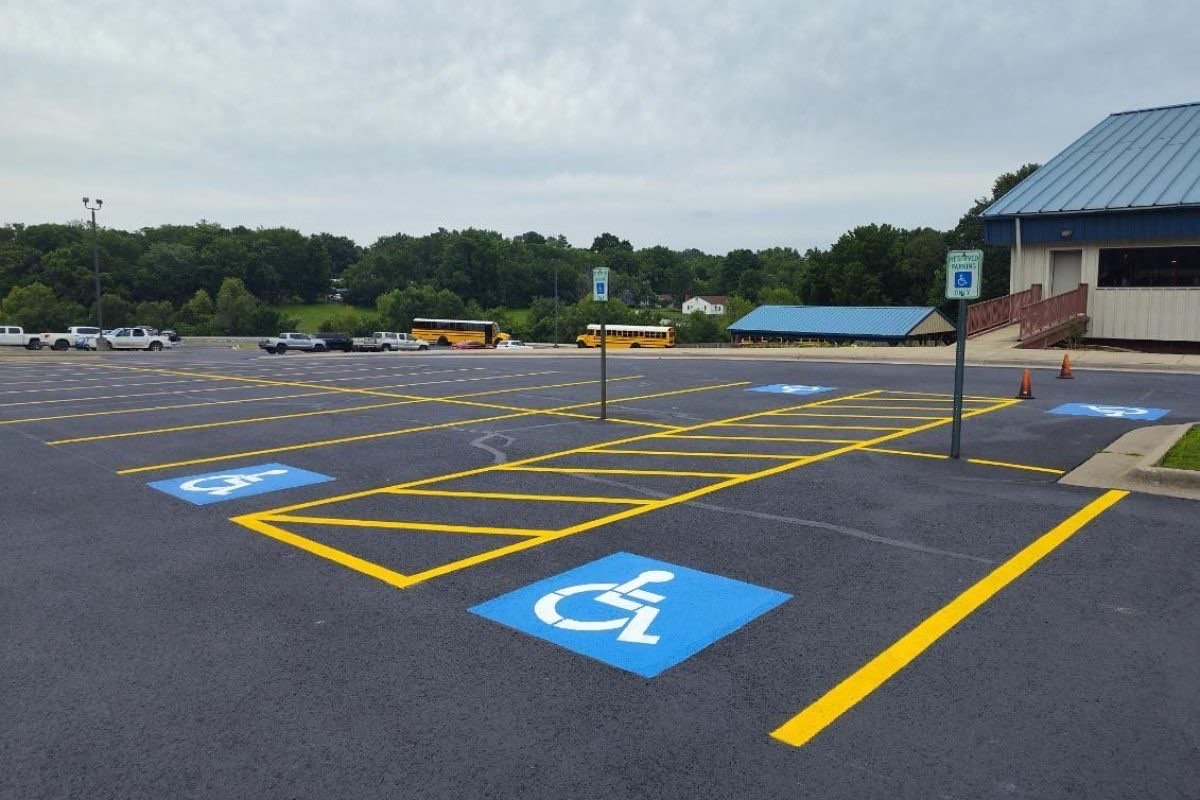
Why Fine Stripes for Parking Lot Striping
Faded stall lines cost you usable spaces. Drivers spread out, the layout stops being obvious, and a lot that was designed for a certain count quietly starts holding fewer cars.
A re-stripe puts the layout back. If the old lines are still readable we work straight over the existing arrangement. If they have worn away we set the layout out from your site plan, or lay out a new one if the way the lot is used has changed.
The part that shows is the layout. We chalk and mask it out before any paint goes down.
Striping looks like a quick job from outside the fence. Machine goes up and down for a few hours, the lot has lines again. Most of what decides whether those lines still work in three years happens before any paint comes out.
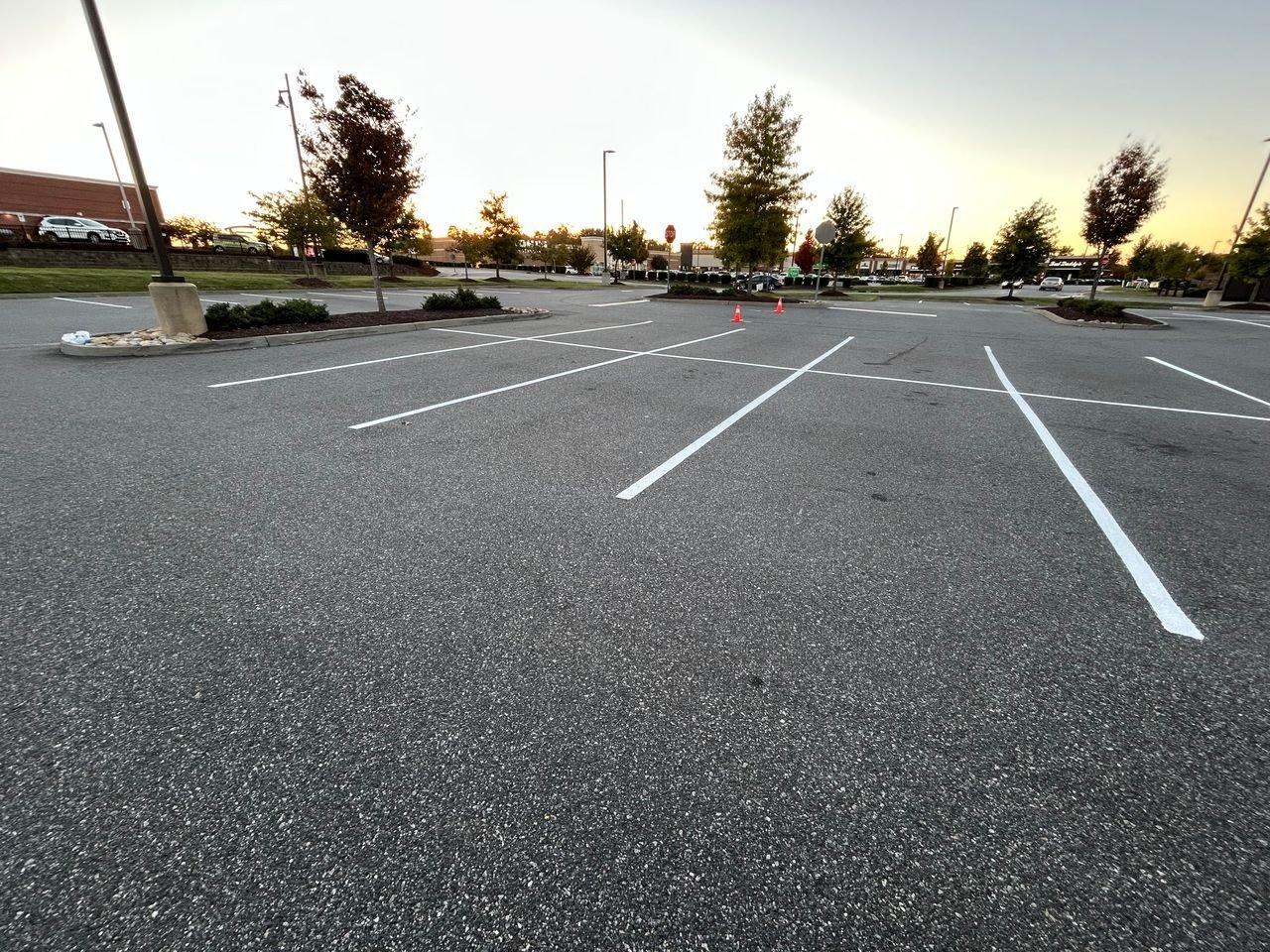
A run of stalls only stays parallel to the far end of the lot if it is measured out rather than copied off the old lines.
How a re-stripe is carried out
Work starts with a walk of the lot, ideally with whoever manages the property. You are looking for whatever changes the plan. An oil-soaked patch by the bin store. A low spot that holds water after rain. A section starting to ravel, wheel stops knocked out of position, parts of the layout that were wrong before anyone repainted them. Better to agree all that standing on the asphalt.
Then the surface gets cleaned. Blowers for the loose grit, brooms along the curb line where dirt compacts, and oily patches treated separately, paint will not hold on contaminated asphalt however good the paint is. Where the dirt has bonded to the surface rather than sitting on it, that step becomes a proper wash rather than a sweep. Dust is the ordinary reason a new line peels off in sheets a few months later.
Layout is the part that shows. Where the old lines still read, a crew can work off them, though it is worth pulling measurements at intervals first, plenty of original layouts were never straight to begin with and copying one just repeats the mistake. Where the lines have gone you set out from a site plan, or measure fresh off something fixed like a light column base. Chalk and string do the stall ends.
Paint goes down last, steady walking pace, gun held at a consistent height. That is what controls film thickness. A line sprayed thin because somebody was hurrying looks the same on the day.
More about parking lot striping
Paint, and why one gets chosen over another
Most commercial lot work uses waterborne acrylic traffic paint. It cures as the water leaves it and suits normal site conditions. Solvent-based still has a place where a surface has to take traffic quickly in cool or damp weather, though its use is restricted in a lot of jurisdictions now on emissions grounds.
One more thing worth settling before anyone books a date. A lot that is going to be sealcoated inside the next year should be striped after the sealer, not before, or the layout gets buried and paid for twice. Same logic with patching. Paint over a patch that is about to be cut out and you have thrown that section away. Sequence first, then dates.
Bare asphalt is porous and drinks the first coat. A lot that has never been striped, or one just sealed, generally wants a second pass to build a proper film. Glass beads get broadcast into wet paint where headlight reflectivity matters, entrance lanes and dark perimeter aisles mostly. Not standard on every stall line. No point putting them down an aisle nobody drives after dark.
| Paint | Where it fits | The trade-off |
|---|---|---|
| Waterborne acrylic | Most commercial lot work, normal site conditions | Cures as the water leaves it, so it wants reasonable weather |
| Solvent-based | Surfaces that must take traffic quickly in cool or damp weather | Use restricted in many jurisdictions on emissions grounds |
| Glass beads (into wet paint) | Entrance lanes and dark perimeter aisles, where headlight reflectivity matters | Not standard on every stall line. No point down an aisle nobody drives after dark. |
Temperature, humidity and the sky
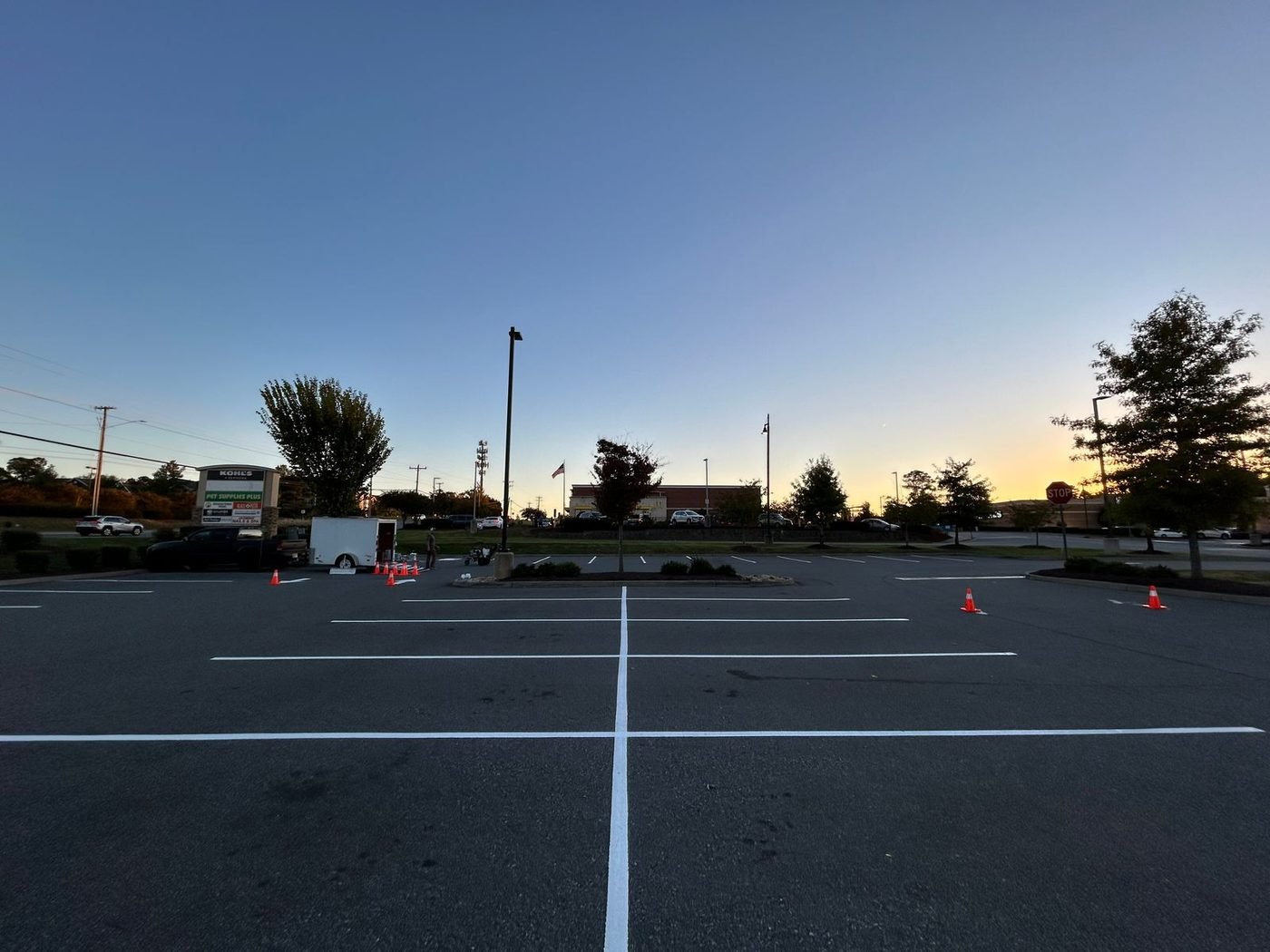
Waterborne paint needs the water to leave it. Surface temperature has to be above the manufacturer minimum and climbing rather than falling, which rules out early mornings in the cold months and the back end of an afternoon late in the season. Charlotte adds the opposite problem in summer. Humidity slows evaporation even when the surface is hot, so drying can take longer on a muggy August day than the thermometer suggests.
We had one this summer about an hour out of Charlotte. Guys got there, chalked the whole lot, and a rainstorm came through and washed every line off before a drop of paint went down. That is the summer here. It comes on fast and the morning forecast does not always see it.
Afternoon storms build fast here and half the time they are not in the morning forecast. Paint rained on before it has skinned over will wash or streak. A crew that watches radar and pulls off the lot at the right moment is not wasting your day. Dew does the same thing in reverse, a lot painted late in the evening can be wet by midnight, and paint laid onto damp asphalt will not bond properly even when the air feels dry.
Fitting the work around a site that cannot close
Very few commercial lots can be handed over empty. Usual approach is to break the lot into sections and cone one at a time, moving as each area dries, so there is always somewhere to put a car. Tight urban lots, medical buildings, restaurants trading in the evening, those are usually better done overnight or at a weekend.
What makes those visits go smoothly is the boring admin done a week earlier. Notices on tenant doors, an email to the staff list, cones out the night before, and a clear position on what happens to a car still sitting in the section when the crew arrives. We ask about that one early, it is the thing that goes wrong most.
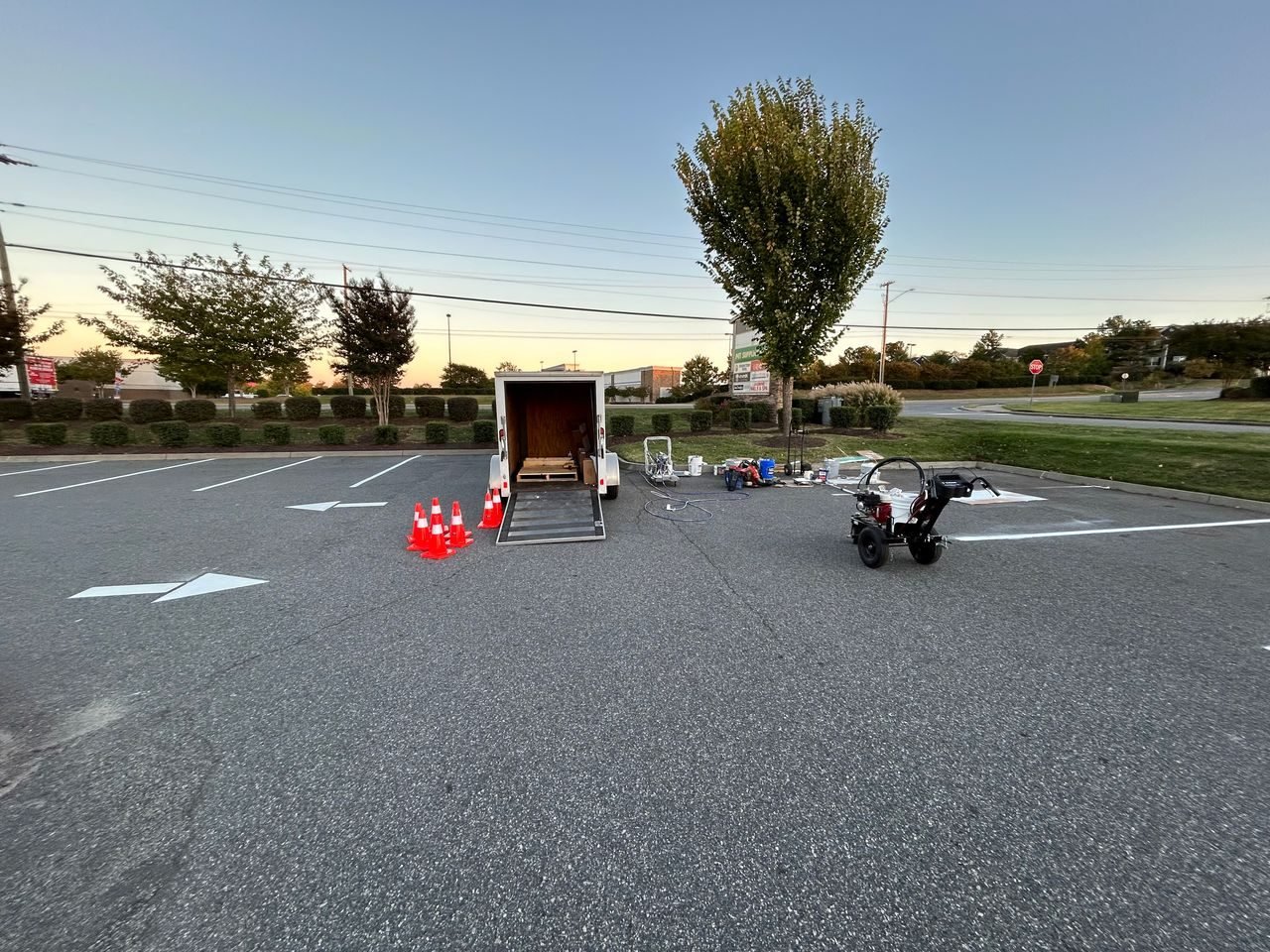
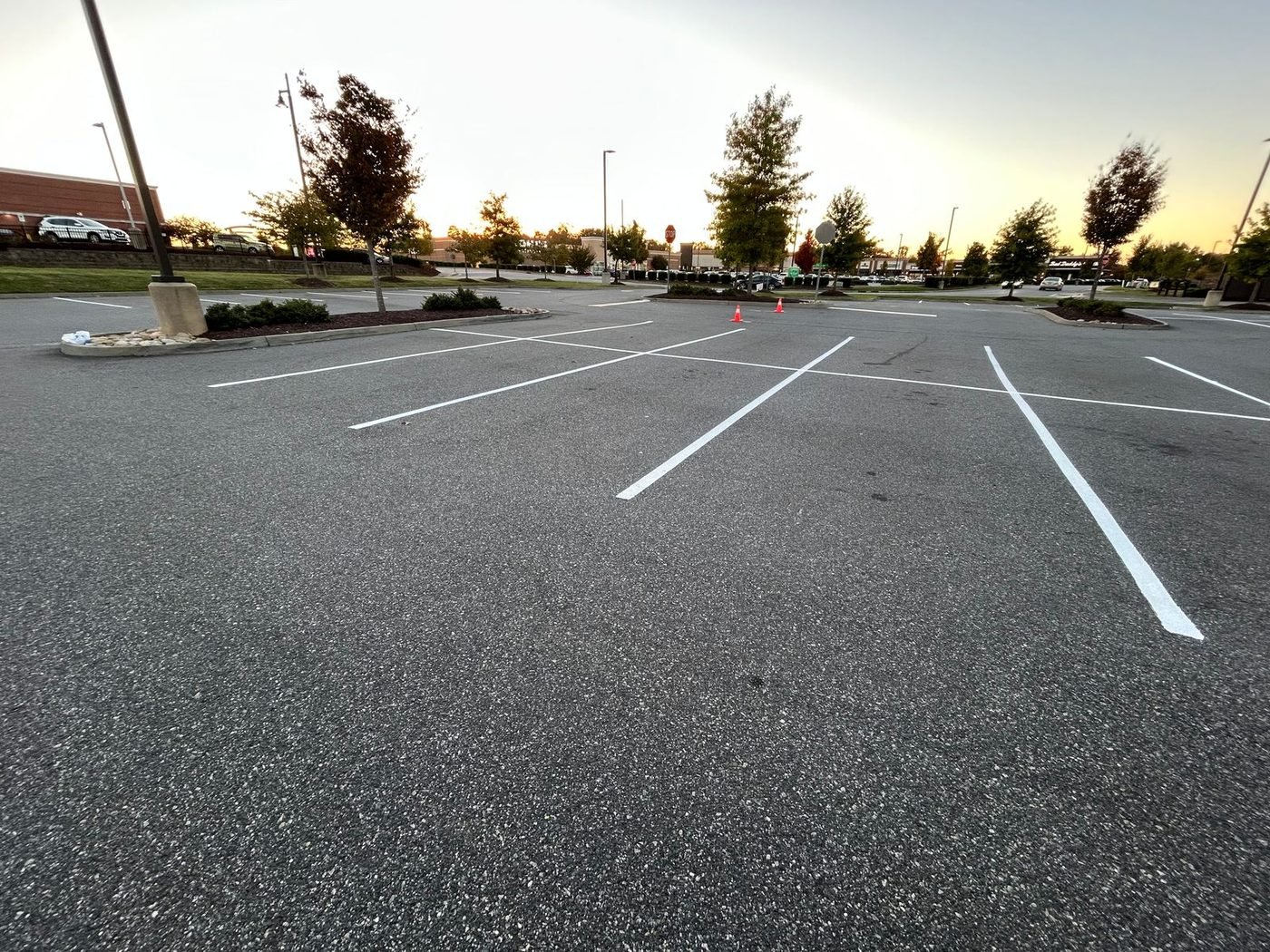
Working a lot in coned sections is what keeps part of it open while the paint dries.
What a badly done lot looks like later
- Lines flaking off in strips. Surface was dirty or damp when the paint went on
- Stall runs drifting out of parallel, so the far end of the lot has spaces nobody can use properly
- Ghosting, where the old faded layout still reads through the new one and drivers park to the wrong set
- Thin chalky paint worn back to grey inside a season
- Paint tracked into the store entrance because the lot reopened before it had cured
- Stall counts quietly dropping, because the crew laid out generously and lost spaces the site plan says you have
More about reading a striping quote properly
Reading a striping quote properly
Two quotes for the same lot can differ enormously and both be honest, because they are describing different work. Make each one say what it actually includes.
- One coat or two, and whether the second is priced separately
- The paint by product name, so somebody can read the data sheet
- Surface cleaning, in the price or assumed already done
- Is the layout a copy of what exists or a fresh set-out, and who supplies the site plan
- Accessible stalls, access aisles, fire lanes and directional markings, counted in or listed as extras
- How the lot gets sectioned and coned, and who notifies tenants
- What happens if it rains on the day. Is a return visit chargeable
Questions worth asking before the work is booked
- Does anything on this lot need filling or patching before paint is worth putting on it?
- Is the surface due for sealcoating soon? If so the striping should probably wait rather than get paid for twice
- How long after the crew leaves can each section take traffic?
- Are the accessible spaces laid out to current standards? A car space wants 96 inches of width and a 60 inch access aisle beside it, and the number of accessible spaces scales with your total stall count, so a lot that has been re-striped a few times has often quietly drifted out of compliance
- Which stalls will be hardest to keep clear, and what is the plan for them?
- If a storm takes the day, when does the crew come back, and who pays for that visit?
That last one matters more than it sounds. Layout quality does not show up on a quote, and the way a contractor talks about the awkward corner of your lot tells you most of what you need to know about how they work.
From your first message to the cones coming up
What actually happens after you send the form, in the order it happens.
-
Step : 01
Tell us about the lot
Property type, roughly how many stalls, and what needs doing. Most re-stripes are priced from that alone. For a straightforward lot nobody needs to come out before you have a number.
-
Step : 02
You get a number, and an order of work
The sequence matters more than the date. Cracks get filled before sealer goes down, and striping goes last once the surface has cured, so a full lot is usually more than one visit. That gets agreed up front rather than discovered on the day.
-
Step : 03
A window that suits the site
Days, nights or weekends. A lot that cannot give up parking during trading hours gets an out-of-hours slot; one with room to work gets coned into sections so part of it stays open throughout.
-
Step : 04
The lot gets walked first
Ideally with whoever manages the property. An oil-soaked patch by the bin store, a low spot that holds water, a section starting to ravel, wheel stops knocked out of position, parts of the layout that were wrong before anyone repainted them. Better to agree all that standing on the asphalt.
-
Step : 05
Surface prep, which is most of the job
Blowers for loose grit, brooms along the curb line where dirt compacts, oily patches treated separately. Paint will not hold on contaminated asphalt however good the paint is, and dust is the ordinary reason a new line peels off in sheets a few months later.
-
Step : 06
Layout, paint, then a walkthrough
The layout is chalked and masked before any paint goes down, measured out rather than copied off faded lines. Traffic-grade paint goes on last at a steady walking pace, and the finished markings get walked with you before the cones come up.
Paint is walk-on dry quickly and takes traffic within a few hours. Most standard lots are done in a single visit, and you get a specific window for your lot and the weather on the day.
See what customers say on Google
Our Google Business Profile carries our reviews, photos and service area, straight from Google, not retyped onto this page.
What customers wrote on Google
“Excellent service from the folks over at Fine Stripes. They completely refreshed our lot, crisp clean lines, quick turnaround time, and excellent customer service. The team was very professional and quick to answer any question I may have had as well.…”
Tre Berry 11 months ago
“Great experience with Fine Stripes of Charlotte! They show up on time, work fast, and the lines look super clean and professional. They can make your lot look brand new and way more organized.…”
Brandon Davidson Charlotte 11 months ago
“They did an excellent job with the sealcoating and striping at our new build out in Ballantyne. The property looks brand new again. Team was easy to work with. Will be using them again.”
Cameron Cartwright Ballantyne a month ago
“Fine Stripes did the striping and sealcoating for our Fifth Third Bank location in Midtown Charlotte. Super high quality work that was completed very quickly. Everything was a breeze The traffic flows so much better now and no one is confused with the layout anymore.”
C.A Photos and Dresses Midtown Charlotte a month ago
“Tyler and his team at Fine Stripes did a great job on the parking lot at our quadplex. We had them stripe and number all of our parking spaces, and the finished product came out even better than what we envisioned.…”
Sharon Lathan 2 months ago
“We had a great experience working with Tyler and Zach at Fine Stripes. They were very communicative from the start and made things as easy as possible. The lot looks great and we’re very satisfied with the work. Highly recommend!”
Kevin Sowinski 2 months ago
Common questions
How long does a re-stripe take?
Most standard lots are done in a single visit. The paint is walk-on dry quickly and takes traffic within a few hours, though we will give you a specific window for your lot and the weather that day.
Do you need the whole lot closed?
No. We usually work in sections and move cones as we go, so part of the lot stays open. For tight sites, an overnight or weekend slot is normally the smoothest option.
Can you match our existing layout?
Yes. If the old lines are still visible we can re-stripe directly over the existing layout. If they have worn away we can work from your site plan or lay out a new arrangement.
What happens if it rains?
Paint will not bond to wet pavement, so we reschedule. Summer storms move through the Charlotte area fast, and rescheduling costs you nothing.
Where we work
Charlotte and the surrounding metro, into the South Carolina border towns.
Price my lot
Tell us the property and roughly how many stalls, and you'll get a number back, no site visit needed for most re-stripes.
Prefer to talk? (704) 741-9893
24/7 crew availability